Waldorf High School Teacher Education Program
Become the Educator Adolescents Remember!
Where Pedagogy Meets Purpose
Over 230 high school teachers across North America and beyond have successfully completed our program, earning their Waldorf Teacher Credentials.
Since 1996, practicing and aspiring Waldorf high school teachers have turned to our Waldorf High School Teacher Education Program to deepen their understanding and mastery of this vocation and receive their Graduate-level teaching credentials.
Program Overview
This certificate is recognized by ASWNA and Waldorf high schools across the globe. Participants focus on specialized subject areas, as well as techniques to help ready adolescents for life as mature adults. Our graduates teach in Waldorf schools across North America as well as in Central and South America, the Middle East, Europe, Asia, and Australia.
Experienced Instructors
Our team of seasoned high school faculty draws upon the proven track record of Waldorf pedagogy and practices. At the same time, they adapt their courses each year to meet today’s changing societal environment and the needs of today’s teenagers.
Low-Residency and Online Format
As a part-time, graduate-level, low-residency program, WHiSTEP is held over three consecutive Julys. In addition to three summer intensives, trainees undertake two years of independent studies including a research project and internship in a Waldorf high school.
Who Should Apply
-
High school teachers wishing to enrich their Waldorf preparation
-
Professionals seeking a career change
-
Practicing educators
Before You Attend, You’ll Need
-
A University degree or equivalent diploma
-
Some experience working with adolescents preferred
-
Preparatory foundational studies in anthroposophy and the arts* (available by signing up for CfA’s “Explorations” program here)
-
Experience in education and adolescent development
*These foundational studies are prerequisite so that applicants come ready to engage in focused study pertaining specifically to the goals, challenges, and responsibilities of high school teachers
As a Student, You’ll Experience
-
Fundamental ideas of the threefold social organism that underlie Waldorf education
-
Physical, psychological, and spiritual aspects of the unfolding human being
-
Development of “living thinking” in yourself and in those you teach
-
Rudolf Steiner’s foundational work Intuitive Thinking as a Spiritual Path: A Philosophy of Freedom and its practical applications to teaching in high school
-
A phenomenological approach to planning and carrying out your lessons
-
How to help each human being live more deeply into the world
Credentials and Career Outlook
Upon successful completion of the program, you’ll receive a Certificate in Waldorf High School Teacher Education recognized at any Waldorf school around the world.
Since its founding, CfA (including its high school program) has been a full member of the Association of Waldorf Schools of North America (AWSNA).
With more than 150 AWSNA member Waldorf schools in North America (37 high schools) and 59 Alliance for Public Waldorf Education member schools (6 high schools) the need for qualified Waldorf high school teachers has never been greater. You can view a complete list of North American Waldorf high schools here.
Application Process, Tuition, and Financial Aid
TUITION
And when you’re ready…

David Barham
Waldorf High School Teacher Education Program, Director
Center for Anthroposophy, Executive Director
Contact David directly with questions about the program.
Book your Clarity Call! Take the First Step toward teaching, with Clarity. In just one conversation, you’ll receive a clear, personalized breakdown of your tuition, funding options, and monthly plan—so you can move forward with confidence. Whether you’re deepening your path or changing direction, we’ll help you understand the transformational and financial pathway forward.
A vibrant low-residency program starting in July 2026
Curriculum Modules
Module 1: Summer I (July 2026)
Two weeks in-person at scenic Southern New Hampshire
(July 11 – 26)
with leading high school teachers in six specialized subjects:
-
English Language & Literature with Nathan Wilcox
-
Fine & Practical Arts with Michal Noer
-
History & Civics with Paul Gierlach
-
Life Science & Earth Science with Jake Gerber
-
Mathematics with Margarita Slavina
-
Physics & Chemistry with Cedar Oliver
Plus artistic courses in:
-
Creative Speech with Debbie Spitulnik & Rachel Cohen
-
Drama with Nathan Wilcox
-
Eurythmy with Laura Radefeld
-
Drawing & Blackboard Drawing with Robin Swain
-
Singing with Meg O’Dell
-
Spatial Dynamics with Jan Lyndes
Studies in adolescent development with David Barham,
anthroposophical core texts with Paul Gierlach, Cedar Oliver, Marisha Plotnik
Module 2: Fall I and Spring I
(September 2026 – March 2027 )
Seminars on Contemporary Topics: Starlight Rays in Darkened Times I, 3:00 – 5:00 pm ET (Online)
Half-day specialized subject seminars in November, January, March (Online)
Individual mentoring sessions (Online)
Module 3: Summer II
(July 2027)
Two weeks in-person at scenic Southern New Hampshire (July 10- 25, 2027)
Module 4: Fall II and Spring II
(September 2027 – March 2028)
Seminars on Contemporary Topics: Starlight Rays in Darkened Times II, 3:00 – 5:00 pmET (Online)
Half-day specialized subject seminars in November, January, March (Online)
Individual monthly mentoring sessions (Online)
Practicum/internship (12-15 weeks)
Module 5: Summer III
(July 2028)
Three weeks in-person at scenic Southern New Hampshire (July 15-30, 2028 )
Includes one-week course in Waldorf Leadership Development (WLD) with Torin Finser & Carla Beebe Comey
Module 6: Research Project
In general, the research project should help the student form a more living relationship to the high school curriculum and the classroom. It should also allow one to undertake something new and original in one’s chosen field. In this respect the research project is more than just a report or a research paper.
Components
The research project includes these three components:
-
a period of study and personal action research.
-
a brief oral presentation during the third summer session.
-
a written paper, complete with an annotated bibliography of all sources used
RESIDENCY ROOM & BOARD INFORMATION
What our students say
The training was rigorous and thorough and overall a great experience. The faculty were extremely knowledgeable, experienced, supportive and fun. The peer group was also wonderful. The whole experience was one I will treasure always. I am so grateful I got to do this training and feel blessed to have met so many amazing people as part of it. I definitely feel more competent and more grounded in the fundamentals for Waldorf education. I also have walked away with great friendships and mentors I hope to call on in the future. I would wholeheartedly recommend this program for anyone who would like to deepen their knowledge and experience of High School Waldorf Pedagogy.
I am so grateful I got to do this training and feel blessed to have met so many amazing people as part of it. Roxana Zirakzadeh, WHiSTEP Class of 2025
What an amazing intense experience of taking a deep dive into the “why” behind what we do in Waldorf schools within a supportive setting of striving colleagues, not to mention the inspiring landscape of the High Mowing campus and the care given to make sure our basic needs are met with delicious food and soul-nourishing activities.
What an amazing intense experience of taking a deep dive into the “why” behind what we do in Waldorf schools within a supportive setting of striving colleagues… Merideth Jackson, WHiSTEP Student
I found this program to be extremely effective in providing me an understanding of what it means to be a teacher at a Waldorf high school. I completed the program feeling much more informed and assured!
I found this program to be extremely effective in providing me an understanding of what it means to be a teacher at a Waldorf high school. Christopher Young, WHiSTEP Class of 2025
As a first year WHiSTEP student, I came away with so many new curriculum ideas, new perspectives on teaching techniques/strategies, and a meaningful deepening of philosophical principles. Being able to meet and interact with Waldorf teachers - both new and well-seasoned - was invaluable.
I came away with so many new curriculum ideas, new perspectives… Bill Ogonowski, First Year WHiSTEP Student
In this program students have the time and opportunity to DWELL ON THOUGHTS about their subject or Anthroposophy; where else are they surrounded by like-minded colleagues?
In this program students have the time and opportunity to DWELL ON THOUGHTS about their subject or Anthroposophy… Paul Gierlach, Instructor
I appreciated all of the variety. There was a nice balance of hands-on work and abstract thinking. Classes felt stimulating and exciting. There was a clear structure and flexibility based on student contributions. I learned a great deal. I can’t believe how much we covered.
I can’t believe how much we covered. (Physical Sciences)
As a member of the WHiSTEP faculty for the past 25 years, I can say with some longer-range perspective that the program has helped to cultivate an entire generation of teachers, many of whom now anchor Waldorf high schools across North America. Although these trainees have come to Wilton with varying degrees of teaching experience, they nearly always leave with the tools to strengthen their grasp of the philosophical and pedagogical underpinnings of Waldorf education. This past summer I was most impressed by the nearly seamless transition crafted by Douglas Gerwin, founder and long-time “Captain” of the program, and David Barham, current director. Both remain committed to building upon the foundational principles of Waldorf education while adapting the program to meet today’s urgent challenges.
The program has helped to cultivate an entire generation of teachers. David Sloan
The class felt like a pure learning experience. I learned a really incredible amount.
I learned a really incredible amount. (History)
I am aware that this journey has just begun, and I feel now like I have got a new pair of glasses to observe the outer world.
I feel now like I have got a new pair of glasses to observe the outer world. Marilia Trimboli, WHiSTEP Class of 2024
I feel my abilities to observe and to notice has been sharpened greatly and I now am noticing things I have seen thousands of times but that I had never really seen. Yesterday evening, I went outside, and my shadow was reflected onto a large maple tree out front. I found myself moving the shadow of my arms, tracing the shape of the tree from the top down into the roots. To see this expansion and contraction and the rhythm of the natural world brings such a sense of wholeness to the individual.
I feel my abilities to observe and to notice has been sharpened greatly. Jake Gerber,WHiSTEP Class of 2024
The teacher was really an admirable example of patience and good humor. She gently guided us to a confident performance, somewhat against the odds! Impressive!
[The teacher] gently guided us to a confident performance. (Eurythmy)
An example of a really engaging, charismatic personality who inspires interest in the material and has a great depth of knowledge and passion to draw from.
…personality who inspires interest in the material. (English)
The instructor was clearly prepared but also flexible to the spontaneity of the students. There was a good balance of hands-on and abstract learning, different materials and individual/partner/group work. There was a lot of depth but also a breadth uncovered through the depth.
There was a good balance of hands-on and abstract learning. (Math)
I appreciated the way the instructor was able to both keep us on track and let us derail and explore off the track when a question took us on an exploration. I also appreciated observing how he would, after a while, gently redirect us back onto the track.
[The instructor kept] us on track and let us derail and explore off the track when a question took us on an exploration (Human Development)
I appreciated the space we gave this year to talking about making new curriculum decisions and the questions we need to consider in doing this. I feel better prepared to make these decisions moving forward.
I appreciated the space… Heather Lomason, WHiSTEP Class of 2023
The instructor is a pro: practical and inspiring. He structures his classes in a way that requires students to bring their best. He brings great resources that teachers can use in their classrooms immediately.
[The instructor] brings great resources that teachers can use in their classrooms immediately (English)
The instructor wove a tapestry of thinking feeling willing that provided an experiential gateway to the philosophy of Anthroposophy. Cedar has an amazing ability to bend time.
…an experiential gateway to the philosophy of Anthroposophy (Living Thinking)
It was disorienting at times, but I feel I needed it to grow.
I needed it to grow. (Drama)
Course catalog
45 courses across three years
First Year15
HS 112Human Development
In the words of Hermann Hesse, the human being “is not a determinate, finite entity, not a being completed once and for all, but a coming-into-being, a project, a dream of the future, a yearning of nature for new forms and possibilities.” Of no period in human development is this more apt a description than of adolescence, that fluid time between childhood and full adulthood. By studying the ebb and flow of inner and outer influences upon the toddler, the child, and the teenager, students will come to understand how human beings develop and how — through the developmental structure of the Waldorf elementary and high school curriculum — they can be helped in their unfolding from earliest years through childhood to adult life. II Overview of Course Content and Methods: Beginning with reflections upon their own teenage years, students will explore the nature of adolescence — its physiol
HS 114Living Thinking: The Basis for Teaching Teenagers
This course will develop experiences of living thinking. Through a process of reflecting on reading assignments, observations, and practical exercises, participants will be encouraged to develop a deeper understanding of this essential aspect of Waldorf education, drawing from Rudolf Steiner’s Intuitive Thinking as a Spiritual Path: A Philosophy of Freedom. Classes will focus on three central themes: - improving our ability to observe our surroundings - developing a conscious understanding of the relation between sense experience and thought - exploring how this process relates to and affects our daily life and work as a teacher - Exercises involving dynamic, lively scenes in the natural world will be investigated to illustrate the challenges posed by the observation of living nature. Through small group work and individual journaling, the relevance of intuitions in ethical individu
HS 120Life Sciences
The students learn how Waldorf education and goethean/phenomenological approach to science are applied and developed in the teaching of biology in the Waldorf high school from grades 9 to 12. II Overview of Course Content and Methods: In the first year the life sciences subject seminar introduces the students to a goethean/phenomenological approach to studying nature and science. We will study the epistemological and scientific background of the approach, together with practical observational activities in botany. III Verification Requirements and Evaluation Methods: The evaluation of the students is based on classroom participation and on any brief assignments and demonstrations given during the seminar. IV Readings: In preparation for the seminar, students should read: Craig Holdrege, Thinking Like a Plant: A Living Science for Life (Great Barrington, MA: Lindesfarne Books,
HS 122English
Ninth graders enter high school full of energy and trepidation, usually eager to learn but often distracted by their own internal upheavals. The aim of this subject seminar is to introduce participants to the challenges of teaching English to adolescents caught between polarities. The seminar will be mostly exploratory and discussion-oriented, relying in large measure upon the questions and interests of the participants. II Overview of Course Content and Methods: Getting Ready: - An overview of the ninth grade curriculum and how it meets the needs of young high school students Establishing Rhythms: - The value of speech work; classroom routine; the three-part lesson A Look at Morning Lesson Blocks: - Comedy and Tragedy, The Novel Building Skills: - The Power of Precision: overcoming sloppy speech, bringing grammar to life - The Importance of Observation: journal writing - Les
HS 124History
In order to place this level of history teaching in its broader context, please read the following “Overview of the History Curriculum”: We have three summers to prepare ourselves to teach four years of history in the Waldorf high school curriculum. History is the biography of humanity. We are who we are at this moment of our lives at least in part because of what has happened in the past. Now, what lies at the heart of our comprehension and teaching of history is the anthroposophical conviction that a human being is actually a spiritual being who is taking on the task of being human. We learn how to be human in all senses of the word. Thus, we can look quite broadly at this human activity and say: in the distant past, humanity shared a one-ness in its nature that, over time and for many reasons, evolved into the creation of many cultures that spread over the face of the globe. Some cu
HS 126Mathematics
HS 126 Subject Seminar (Level I): Mathematics Credits: 1 Faculty: Jamie York I Projected Learning Goals and Objectives: To come to an understanding of how Waldorf education is practiced and developed by math teachers in a Waldorf high school. II Overview of Course Content and Methods: The following topics will be included: - An overview of the Waldorf mathematics curriculum. - The Waldorf high school math main lesson curriculum and its relationship to adolescent development. - The various aspects of Geometry as taught in Waldorf schools. Special emphasis will be given to the 10th grade Greek Geometry main lesson (including Euclid’s The Elements), and the 10th grade geometry track class. - An overview of the history of mathematics and how it relates to the various mathematics courses as taught in a Waldorf high school. - Investigation and discussion regarding the following cent
HS 127Physical Sciences
Each participant will be encouraged to develop an understanding of the methods associated with phenomenological or sense based science. Comparisons between the methods of sense based science and more classical approaches will be both encouraged and investigated. The emphasis will be placed on developing understanding through individual experience so that later presentations in the classroom are rich and authentic. The physical science curriculum in all four grades will be surveyed with specific examples given as needed. Various discussions concerning implementation of the curriculum and the relationship to the developing adolescent will also take place, followed by a more in depth investigation of the 9th grade Thermal Physics block. II Overview of Course Content and Methods: The class will have two central themes. The first will be to work with various phenomena associated with the 9
HS 128Arts/Art History
The visual arts and crafts curriculum in the Waldorf school is reviewed and characterized, particularly from grades 6-12. Depending on the background and needs of the course participants, representative and relevant artistic exercises will be taken up during these classes, though we most often explore Waldorf curriculum appropriate drawing techniques using pencil, ink, or compressed charcoal in this first year. We also discuss teacher-student dynamics and best pedagogical methods for success in the classroom, including the crucial acquisition of practical-artistic skills and the all-important need for inner self-development. II Goals: An in-depth, experiential understanding of the arts curriculum and how it corresponds to the child’s evolving consciousness. To inspire art that builds upon the themes of the high school years. III Materials: Students should be prepared with a noteboo
HS 132Drama
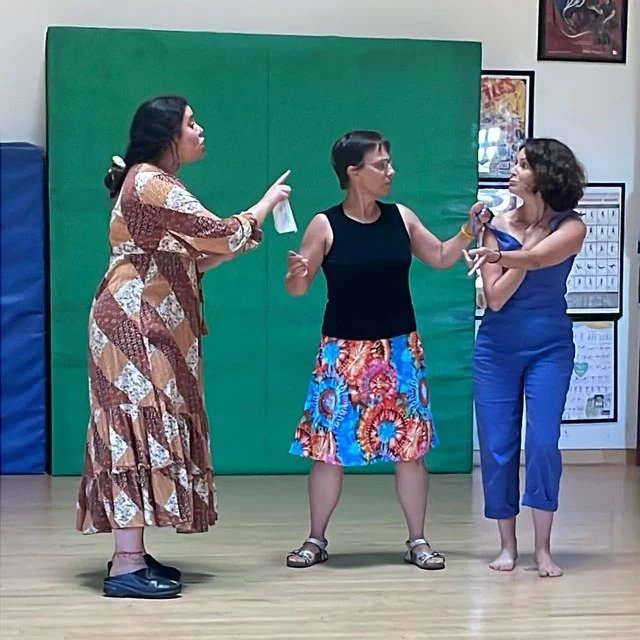
Drama productions at the high school level can be memorable, incarnating experiences both for students and for the entire school community. Since the theatrical journey is as important as the destination, we will work with a sequence of rehearsal exercises designed to help students imagine characters and, ultimately, plays into being. Movement, speech, gesture, timing will receive special emphasis. The goal here is to offer participants an insight into why the dramatic process can be a mini-initiation for all involved. II Overview of Course Content and Methods: Exploring the Physical: moving through space, learning mobility, employing meaningful gestures Charging the Atmosphere: working with the elements, evoking and altering mood, filling the space with feeling Creating the Character: psychological gestures, locating “centers,” playing with props, discovering voices Bringing th
HS 134Eurythmy
This course is designed to give prospective high school teachers a lively personal experience of the art of eurythmy and its role in the Waldorf high school. Students are expected to have had an introduction to eurythmy as prerequisite to this course. The goals of this course are to enliven students’ experience and understanding for eurythmy and its relationship to the high school curriculum, as well as to facilitate a deeper understanding of Rudolf Steiner’s vision of the human being through eurythmy. The course will demonstrate how eurythmy bridges themes from the curriculum through poetry, music, movement styles, etc. Classes will require some documentation of course work. II Outline of Topics to be Covered: An introduction to basic speech and music eurythmy principles including contraction and expansion, dynamic of moving straight lines and curved forms, visible expression of spe
HS 136Music
Learning Goals This course invites high school teachers and prospective teachers to develop their own musicality through singing, rhythm exercises, and improvisation. We employ musical elements from many different cultures. We explore the high school choral repertoire of the past and of the present and consider how singing programs might be shaped to meet the needs of high school students in the future.
HS 137Painting
Learning Goals - To experience colors in their archetypal qualities free from the constrictions of outer form: the laws and the language of colors and their effects on the human soul as researched by Goethe, Steiner, Kandinsky, and Collot d’Herbois - To experience the activity of painting and its relevance to education - To develop an integrated experience of color that can serve the Waldorf curriculum throughout the high school grades Content - Discover color as creative being through observation and experience - Experience active and passive colors as they relate to soul gestures. Study primary and secondary colors, complementary colors, warm and cool range of colors - Deepen pedagogical understanding of nerve-sense, rhythmical, and metabolic aspects of the human being and the way they are expressed in color Method - Introductions and demonstrations: Students work on common th
HS 138Dynamic Speaking I
- To discover the nature and role of the spoken word in evolving connection between world and individual - To explore the qualities of the sounds of speech through an experience of listening to and reciting poetry - To develop an appreciation of the three styles of poetry: epic, lyric, and dramatic, in connection with the human being’s differentiated relationship to the world - To work with the Morning Verses in connection with the contrast of ‘outer and inner’: the conversation between the world and the individual - To develop an awareness of the role of the breath - To develop an awareness of inner form and movement in speech - To learn to work with some of the speech exercises for Waldorf teachers II Overview of Content and Methods: Following an introduction to the day’s subject and focus, classes will consist of group and individual speaking of speech exercises and texts. In
HS 139Sculpture
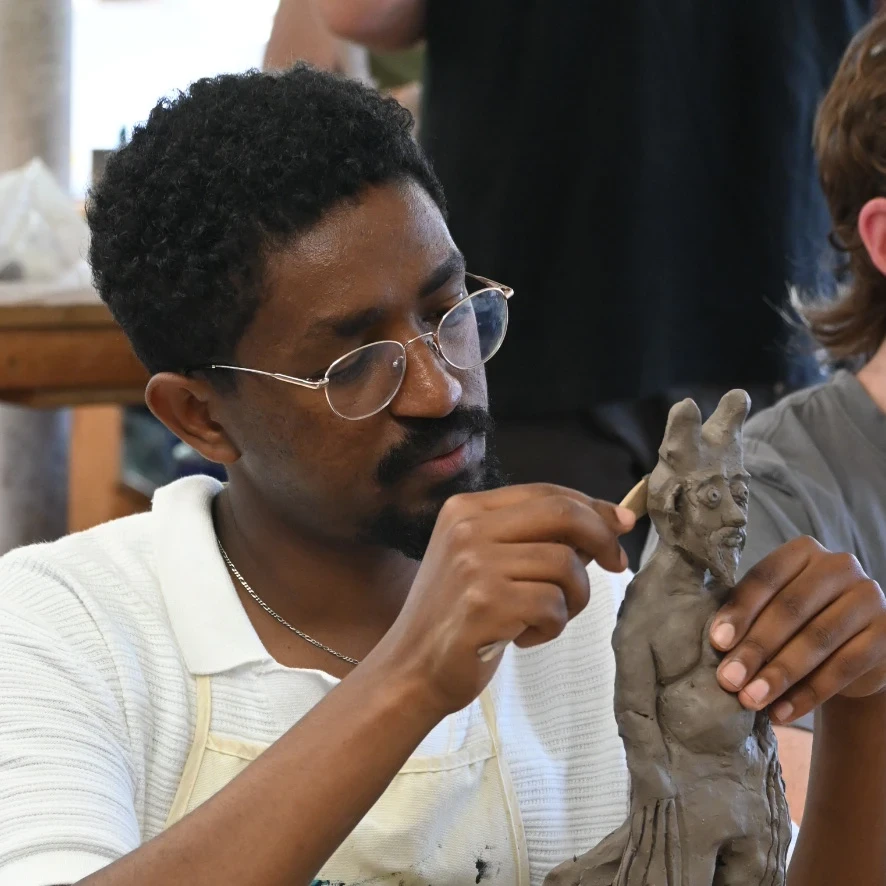
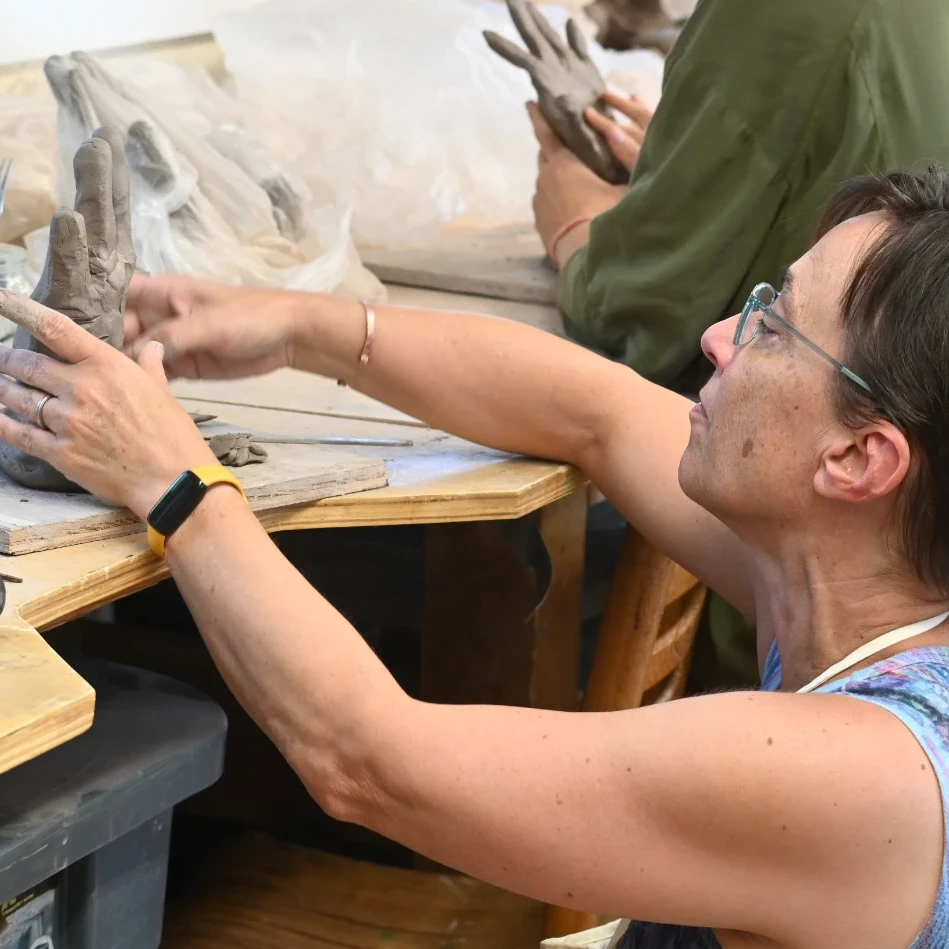
To introduce students to the activity of clay modeling/sculpture in its fundamental artistic principles and to gain sufficient artistic capacities through practice. To acquire an understanding of the special importance, role, and curriculum applications of these aesthetic activities to child, adolescent, and adult development. II Overview of Content and Methods: Following an introduction to the day’s theme, classes will consist of demonstrations and guided exercises. Reflective discussions will round out the sessions. III Outline of Topics to be Covered: - Experiencing living sculptural processes through the medium of clay modeling. - Basic exercises for the teacher and for the high school classroom. Themes we will explore - The language of form, including the Platonic forms and their transformation. - The modeling of living surfaces that gives expression to the forces of grow
HS 140Spacial Dynamics
A deeper understanding of movement, spatial awareness, and human development. Age-appropriate movement activities for high school-age students, as well as work on our own movement as teachers. II Overview of Course Content and Methods: Through movement activities and spatial awareness exercises we will explore themes such as: - human uprightness - spatial streams and posture - forces of gravity and levity - center and periphery - movement and counter-movement - personal/interpersonal space and sense of self/other - movement and its threefold relationship to thinking, feeling, and willing III Verification Requirements and Evaluation Methods: Honoring the variance in levels of ability among the participants, students will be asked to take part as fully as possible and with a willingness to engage in all activities. Students should be open to the possibility of change and furth
Second Year17
HS 210Renewal Course
Students will take one of the following seminars this year taken from a selected roster of Summer 2022 Renewal Courses. “Starry Inspiration for Earthly Deeds, Diversity, and Healing” Elan Leibner with Jenny Foster “Make Up Your Mind: Navigating Color Through Polarity” Charles Andrade “What a Character! Learning to Face Encounters ‘I’ to ‘I’ ” Chris Burke and Anne DeWild “Social Vibrancy through the Arts of Music and Eurythmy: The Healing Nature of Tone” Jeff Spade and Jenny Foster “Cosmic Cycles, Earthly Rhythms” Mary Stewart Adams, star lore historian Read the course descriptions(https://centerforanthroposophy.org/programs/renewal-courses/).
HS 212Pedagogical Anthropology
Students will: - become familiar with Rudolf Steiner’s understanding of human nature by reading and working on the lecture cycle First Teachers’ Course - begin to discover the implications of this understanding for the education of high school student - connect this seminal lecture cycle with material in other major works by Rudolf Steiner, especially Education for Adolescents, Anthroposophical Leading Thoughts, and Practical Training in Thought - use at least four ways to conceptualize the texts: outline, summary, paraphrase, and precis. II Overview of Course Content and Methods: This course focuses on the nature of the human being as described in Rudolf Steiner’s First Teachers’ Course, a series of 14 lectures that Steiner held directly prior to the opening of the first Waldorf School in 1919. In these lectures, Steiner discusses the physical, psychological, and spiritual nature
HS 216Esoteric Science
Learning Goals This course examines the esoteric history of the human being. By looking at various cosmological and historical phenomena, we will try to find the reflections of the anthroposophical view of human development by making wide sweeps through world history. Students should leave the course with a basic understanding of the spiritual scientific approach to the evolution of human consciousness. In addition, we will examine tools to spiritual self-development as outlined by Rudolf Steiner. Course Content Using Esoteric Science by Rudolf Steiner as the basic text, both teacher and participants will explore and present sections of the text to the class. Each student is expected to present a portion of the text to the rest of the class. Questions and discussion are encouraged in this exploration. By the end of the course, students will be asked to present an art project or short
HS 218Professional Seminar
- Examine Rudolf Steiner’s description of the threefold nature of social life as it 1) corresponds to the threefold human being and 2) applies to education. - Identify a subject of interest to the students that could become a year-long research project. - Explore different approaches to independent research in order to introduce them to highs school students. - Write up the Research Project in the proper format and submit to the Chair of the high school program by the end of the summer session. II Overview of Course Content and Methods: This course looks at the way Waldorf education creates healthy social life by addressing the threefold nature of the human being (threefold social organism). It then gets down to the particulars of the life of teaching by investigating research methods, both in and outside the classroom. We will draw upon ideas and experiences of all participants in
HS 220Life Sciences
The students learn how Waldorf Education and a goethean/phenomenological approach to science are applied and developed in the teaching of biology in a Waldorf high school from grades 9-12. II Overview of Course Content and Methods: The seminar will focus on: - How the biology curriculum in grades 9 & 10 can help students exercise explanatory (linear) thinking and dynamic (process-oriented) thinking. - Content out of the curriculum (grades 9-10) - The form (“gestalt”) of a main lesson. - Presentations and discussions of research projects by second and third year students III Verification Requirements and Evaluation Methods: The evaluation of the students is based on classroom participation and the work they have completed during the independent study period to prepare for the seminar, including independent research project (written) and presentation. IV Readings: As specified
HS 222English Literature
Participants will continue to deepen their exploration of adolescence and how the curriculum in the eleventh and twelfth grades can both mirror and foster transformation into young adulthood. However, the winds of change are blowing briskly through Waldorf high school classrooms. We will consider how to assess which courses in the “traditional canon” to keep, and which—if any—to supplant or supplement. The seminar will focus on literature blocks in these two grades, including any presentations that the participants have been preparing during their independent studies. Since virtually all of the participants are currently teaching in Waldorf settings, their questions and challenges will help inform and direct our discussions. II Overview of Course Content and Methods: Weeks 1 and 3 Students will have the opportunity to present culminating work of year-long research projects. Presenter
HS 224History
In order to place this level of history teaching in its broader context, please read the following Overview of the History Curriculum: We have three summers to prepare ourselves to teach four years of history in the Waldorf high school curriculum. History is the biography of humanity. We are who we are at this moment of our lives at least in part because of what has happened in the past. Now, what lies at the heart of our comprehension and teaching of history is the anthroposophical conviction that a human being is actually a spiritual being who is taking on the task of being human. We learn how to be human in all senses of the word. Thus, we can look quite broadly at this human activity and say: in the distant past, humanity shared a one-ness in its nature that, over time and for many reasons, evolved into the creation of many cultures that spread over the face of the globe. Some cult
HS 226Mathematics
HS 226 Subject Seminar (Level II/III): Mathematics Credits: 2 Faculty: Jamie York I Projected Learning Goals and Objectives: To develop a deep understanding of the nature of mathematics; to learn how mathematics can aid adolescent development; to learn how to work with and develop a comprehensive mathematics curriculum; and to develop the ability to work effectively in a Waldorf school. II Overview of Course Content and Methods: The following topics will be included: - The high school math curriculum and its relationship to adolescent development - The history of mathematics and its relationship to the evolution of consciousness. - Specific details for the teaching of the following topics may include (depending upon the year): - Heron’s Proof - The Geometry of Descartes - An introduction to trigonometry - Calculus (main lesson) - 12th grade math track class (both advanced a
HS 227Physical Sciences
Each participant will be encouraged to develop an understanding of the methods associated with phenomenological or sense-based science. Comparisons between the methods of sense-based science and more classical approaches will be both encouraged and investigated. The emphasis will be placed on developing understanding through individual experience so that later presentations in the classroom are rich and authentic. The physics curriculum in all four grades may be briefly surveyed but major emphasis will be on the 11th and 12th grade. Various discussions concerning implementation of the curriculum and the relationship to the developing adolescent will also take place. II Overview of Course Content and Methods: The class will have two central themes. The first will be to work with various phenomena associated with the curriculum to illustrate the methods used in the classroom while also
HS 228aArts/Art History
I Overview of Course Content and Methods: Depending on the background and needs of the course participants, representative and relevant artistic exercises will be taken up in class. Projects may include clay modeling, wood or stone sculpture, form drawing, and/or a variety of drawing techniques using pencil, ink, or charcoal. Painting and other arts and crafts skills will be incorporated using guest faculty. We will continue to discuss the role of the teacher and best methods for success in the classroom, including the acquiring of practical-artistic skills and the all-important need for inner self-development. II Goals: An in-depth, experiential understanding of the arts curriculum and how it corresponds to the child’s evolving consciousness. To inspire art that builds upon the themes of the high school years. III Materials: Materials will be provided as needed or purchased at t
HS 228bArt History
I Projected Learning Goals and Objectives: A continuation of a phenomenological approach to art history as an outer expression of the evolution of consciousness, as it pertains to painting, sculpture, and architecture. Classes will serve as a forum for discussion on how to bring the material to life and relevance in the classroom. II Overview of Course Content and Methods: We will utilize slide presentations, discussions, and independent reading. Through observation of works and images, we will practice the objectifying of our perceptions and the training of our aesthetic sensibilities. By means of this practice, we see how the archetype of beauty—as well as the stages of human consciousness—metamorphose over time III Verification Requirements and Evaluation Methods: Evaluation of students will be based on the quality of classroom participation and the level of engagement in any
HS 232Drama
The aim of this workshop is to help participants strengthen the tools of the teacher as well as the actor — speech, gesture, inner mobility, imagination, presence of mind, the ability to improvise, powers of observation, ensemble awareness. II Overview of Course Content and Methods: We will recap the work of the first-year course, using a variety of drama exercises to develop character and relationship. Most of our energies will be spent exploring planetary qualities. Improvisational techniques may provide the basis for never-before-imagined and never-again-performed scenes. III Verification Requirements and Evaluation Methods: Evaluation will be based solely upon the fullness of students’ participation. IV Suggested Readings: Peter Bridgmont, The Spearthrower (An Grianan, 1983) Michael Chekhov, To the Actor (Harper and Row, 1953) Keith Johnstone, Impro (Routledge, Chapman and
HS 234Eurythmy
This course is designed to deepen the experience of the art of eurythmy and its context in the Waldorf high school curriculum. As an upper level course, it assumes participants have taken teacher education eurythmy level I or its equivalent. The goals of this course are: - Continue to develop understanding and appreciation for eurythmy and its role in the high school - Facilitate a deeper understanding of Rudolf Steiner’s vision of the human being through eurythmy - Facilitate understanding of eurythmy as a path of development of “initiative of soul and initiative of will” This course also aims to give tools to experience eurythmy as a support to ongoing personal and professional development as a Waldorf teacher. It will bridge eurythmy with themes from the curriculum through poetry, music, movement styles, etc. Classes will require some documentation of course work. II Outline o
HS 236Music
Learning Goals This course will invite high school teachers and prospective teachers to develop their own musicality through singing, rhythm exercises, and improvisation – employing musical elements from many different cultures. We explore the high school choral repertoire of the past and present and consider how singing programs might be shaped to meet the needs of high school students in the future.
HS 238Dynamic-Speaking
- To further understand the nature and role of the spoken word in the evolving connection between world and individual - To develop the ability to work with lyric, epic, and dramatic poetry as well as with prose by practicing various curriculum-related texts and related exercises, and to integrate this practice into an understanding of the threefold nature of the human being - To work further with healthy breathing, inner gesture, and imagination - To approach an understanding of the role of speech in the inner development of the Waldorf teacher - To work with the rhythms of poetry in connection with developing a healthy relationship to time - To learn to support and develop living thinking through speech - To work with the Morning Verse in connection with the contrast of ‘outer and inner’: the conversation between the world and the individual - To progress in the work with the te
HS 239Sculpture II
A deepening of the practice of clay sculpture in its fundamental artistic principles constitutes the basis of this course. The importance and relevance of the artistic exercises as supportive of adolescent development will be discussed, especially in relation to the content of Rudolf Steiner’s First Teachers’ Course (a.k.a. Study of Man). Appropriate Waldorf curriculum indications for sculpture and related subjects are given. II Overview of Course Content and Methods: Following an introduction or review of the day’s theme, classes will consist of demonstrations and guided sculptural practice III Outline of Topics to be Covered: Week 1 - Review of fundamentals from Year I - Exploring gesture and language of form in clay Weeks 3-5 - Sculpting the Human Form IV Verification Requirements and Evaluation Methods: Students will be evaluated on their attentiveness and degree of part
HS 240Spacial Dynamics II
A deeper understanding of movement, spatial awareness, and human development. Age-appropriate movement activities for high school-age students, as well as work on our own movement as teachers. II Overview of Course Content and Methods: Through movement activities and spatial awareness exercises we will explore themes such as: - human uprightness - spatial streams and posture - forces of gravity and levity - center and periphery - movement and counter-movement - personal/interpersonal space and sense of self/other - movement and its threefold relationship to thinking, feeling, and willing Special attention will be given to participants’ areas of specialization and the incorporation of Spatial Dynamics awareness and practices. III Verification Requirements and Evaluation Methods: Honoring the variance in levels of ability among the participants, students will be asked to take
Third Year13
HS 310Personal and Organizational Renewal
Course Outline Participants explore how personal well-being affects organizational health and how organizational structure of Waldorf schools can enhance or diminish individual accomplishment. Topics covered include: group dynamics, leadership styles, working with conflict, communication, mediation, artistic practice, finding the balance between personal and professional demands. These themes are supported by exercises of eurythmy in the workplace.
HS 318Professional Seminar
Learning Goals This seminar, focusing on the professional development of the teacher, will complement the various subject seminars by taking up practical topics of common concern to all Waldorf high school teachers, including the gentle art of qualitative research. The format will be interactive, with students and faculty sharing observations and roles. Course Content Particular attention will be paid to the questions that arise in our-day-to-day teaching, including exercises to warm up a class, rhythms in teaching, different learning styles, and techniques for addressing different age groups. Attention will also be paid to independent research strategies as well as thefundamental ideas of the threefold social organism that underlie Waldorf education. These sessions will be practical in nature, taking the form of discussions, exercises, skill building, role plays, and so on. Students
HS 320bLife Sciences – Biology
Learning Goals The students learn how Waldorf Education and a goethean/phenomenological approach to science are applied and developed in the teaching of biology in a Waldorf high school from grades 9-12. Course Content The seminar will focus on: - How the biology curriculum in grades 9 to 12 can help students learn complex and holistic thinking. - Content out of the curriculum (grades 9-12) - The form (“gestalt”) of a main lesson. - Presentations and discussions of research projects by second and third year students
HS 322English Literature
Learning Goals Participants will continue to deepen their exploration of adolescence and how the curriculum in the eleventh and twelfth grades both mirrors and fosters the transformation into young adulthood. The seminar will focus on literature blocks in these two grades, based on presentations that the participants have been preparing during their independent studies. Course Content Week 1 Student presentations constitute the culmination of year-long research projects. Each student will present a three-week main lesson plan and one sample class (45 minutes total). Presenters should prepare copies of their research to give to members of the seminar as background material for teaching literature blocks. An annotated bibliography supporting the research should be included. Week 2 Eleventh grade is a year of inner and outer journeys, of quests and questions. We will pay particular at
HS 324History
Learning Goals In the junior and senior years, it is vital that students of history learn and retain factual information. Yet the Waldorf teacher aims for something much deeper. In the words of Werner Glas: “It is through living with and into images and pictures with will-filled attention that the act of experiencing can be infused with a seed-like quality and a sense of the future. . . .Rudolf Steiner wanted the lessons to be not for the brain alone, but for the whole human being.” How can we meet the challenge of giving both historical fact and imaginative picture their due? By deepening our understanding of the symptomatological approach, and by examining developmental changes in the junior and senior years, we gradually gain the confidence needed to teach out of Inspiration. Course Content Week 1 We will resume some “Big Picture” considerations of teaching history to juniors and
HS 326Mathematics
Learning Goals To develop a deep understanding of the nature of mathematics; to learn how mathematics can aid adolescent development; to learn how to work with and develop a comprehensive mathematics curriculum; and to develop the ability to work effectively in a Waldorf school. Course Content The following topics will be included: - The high school math curriculum and its relationship to adolescent development, the history of mathematics and the evolution of consciousness. - Specific details for the teaching of the following topics: The works of Archimedes, Surveying, Descriptive Geometry, Calculus (main lesson), imaginary/complex numbers. - Practical aspects of teaching high school math. (e.g., homework, testing, remedial needs, etc.) - Preparation for further study. (e.g., What does it mean for a middle school student to be prepared for high school, and for a high school studen
HS 327Physical Sciences
Learning Goals Each participant will be encouraged to develop an understanding of the methods associated with phenomenological or sense-based science. Comparisons between the methods of sense-based science and more classical approaches will be both encouraged and investigated. The emphasis will be placed on developing understanding through individual experience so that later presentations in the classroom are rich and authentic. This year we will focus on the curriculum of the 12th grade, Visual Physics and perception. By combining an overview of the Visual Physics block with some of the latest research using phenomenlogical methods, each participant will gain a clearer understanding of how to approach a number of topics in a thoughtful and pedagogically appropriate manner. Course Content The class will have two central themes. The first will be to work with various phenomena associat
HS 328Arts/Art History
Learning Goals The Waldorf curriculum spans twelve years. In the final four years of high school the arts are no longer integrated into the main lesson material but nevertheless play an integral role in confirming and balancing the adolescent’s development. Art becomes the mediator between the physical, etheric, astral bodies, and incoming ego as the awakening adolescent develops an increasingly individualized relationship to the world. Art classes have the subtle task of touching the high school student’s sacred dreams. They can help set in motion impulses that stir the unfolding of individual destiny. Course Content In these sessions we will continue our studies and hands-on experience of the arts curriculum appropriate to the adolescent. This year the emphasis will be on group and individualized drawing and sculpture exercises. Linear, gesture, charcoal, and black and white shaded
HS 334Eurythmy
Learning Goals This course is designed to deepen the experience of the art of eurythmy and its context in the Waldorf high school curriculum. As a level III course, it assumes participants have taken teacher education levels I and II eurythmy or equivalent. The goals of this course are: to support prospective teachers deepen their relationship to anthroposophy and the Waldorf pedagogy through the path of eurythmy; to facilitate a deeper understanding of Rudolf Steiner’s vision of the human being through eurythmy experiences; and to clarify understanding of eurythmy as a path of development of “initiative of soul and initiative of will” in the context of Waldorf education. This course will provide experiences from the eurythmy curriculum of the Waldorf high school. Classes will require journaling as a method of documenting and reflecting upon class experience and will be reviewed at th
HS 336Music
Learning Goals This course invites current and prospective high school teachers to develop their own musicality through singing, rhythm exercises, and improvisation – employing musical elements from many different cultures. We explore the high school choral repertoire of the past and present and consider how singing programs might be shaped to meet the needs of high school students in the future.
HS 338Speech
Learning Goals - To further understand the nature and role of the spoken word in the evolving connection between world and individual - To develop the ability to work with lyric, epic, and dramatic poetry as well as with prose by practicing various curriculum-related texts and related exercises, and to integrate this practice into an understanding of the threefold nature of the human being - To work further with healthy breathing, inner gesture, and imagination - To approach an understanding of the role of speech in the inner development of the Waldorf teacher - To work with the rhythms of poetry in connection with developing a healthy relationship to time - To learn to support and develop living thinking through speech - To work with the Morning Verse in connection with the contrast of ‘outer and inner’: the conversation between the world and the individual - To progress in the
HS 339Sculpture
Learning Goals A deepening of the practice of sculpture (clay modeling) in its fundamental artistic principles constitutes the basis of this course. The importance and relevance of artistic exercises as supportive of adolescent development are discussed, especially in relation to the content of Rudolf Steiner’s Foundations of Human Experience. Appropriate curriculum indications are included. Course Content Following an introduction of the day’s theme, classes consist of demonstrations and guided exercises, as well as individual work on given themes and some group projects. Topics Covered - Techniques of sculpting - Flat and curved surfaces - Platonic solids - Contrast/polarity in form - Three-foldness, balance, rhythm - Metamorphosis - Human and animal forms - Metamorphosis of form in skeletal anatomy
HS 340Spacial Dynamics
Learning Goals We seek a deeper understanding of movement, spatial awareness, and human development. We explore age-appropriate activities for high school students, as well as work on our own movement as teachers. Topics Covered - Posture: feet, knees - Bothmer exercises: “fall in space” - Realm: The Dragon - Posture: hips, ribcage - Bothmer exercises: “phoenix”, “cross” - Realm: The Lion - Posture: shoulders, neck - Bothmer exercises: “dome”, “nautilus” - Realm: The Eagle - Posture: head - Bothmer exercises: other movements, review - Realm: The Human
Faculty
See all 11 Waldorf High School Teacher Education Program faculty →